I cannot say how many times I have found myself in the backyard of some client, gazing over a steep bank, and hearing a heavy sigh. “I suppose you have ruled out a pool, eh?” they enquire, kicking a lump of earth downhill.
If this sounds like you, there is good news and a reality check. The answer is: Yes, absolutely. Actually, some of the most beautiful, award-winning pools I have ever designed were constructed on extreme slopes. A flat yard is simple, of course, but a sloping yard? The drama, the views, and the actual wow factor are found there.
Nonetheless, building a pool on sloping ground is not a simple matter of digging a hole and plopping it in. It takes a little more engineering, a little more budget, and a lot more creativity. When you are staring at the hill in your backyard and longing to have a summer oasis, this is all you need to know about making it happen.
Engineering a Pool on a Slope: Gravity and Physics
In a flat yard, the ground holds the pool walls equally. Gravity attempts to make things more challenging on a slope. We normally need to use one of two principal strategies (or a combination of the two) depending on the severity of the grade:
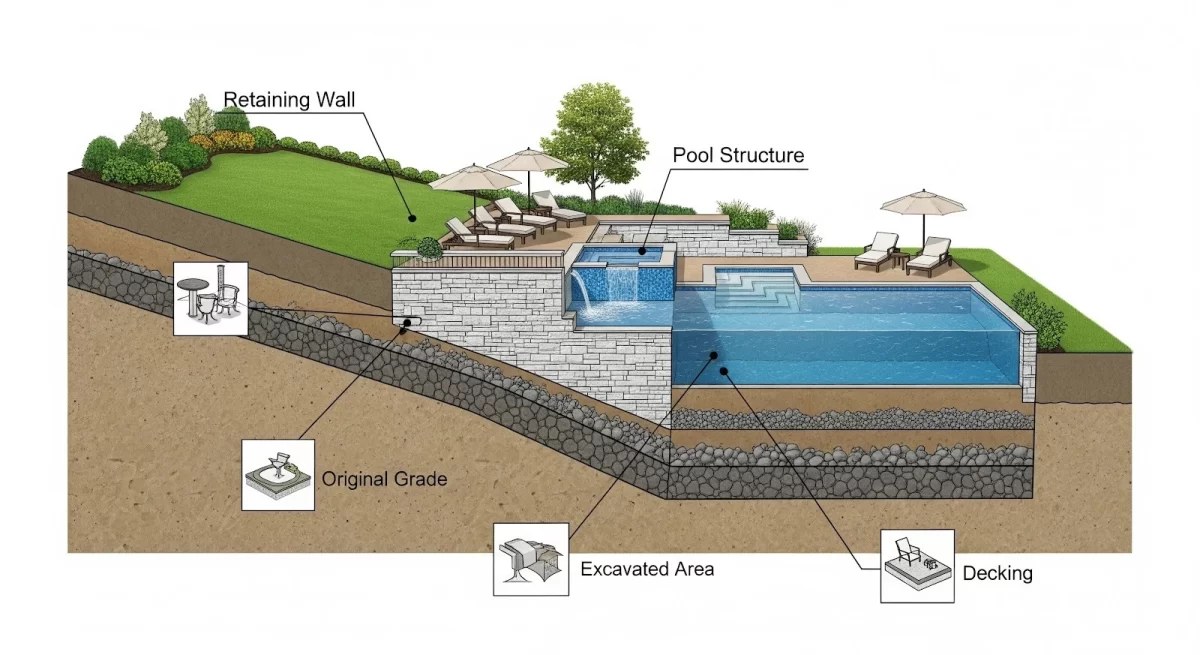
- Cut and Retain: After excavating into the slope, a retaining wall is constructed to hold back the earth, forming a flat shelf for the pool.
- Build Up: This grade is made on the lower side, with the pool wall itself acting as a retaining structure constructed out of the ground.
The two alternatives have aesthetic and engineering needs. Let’s break down how to pull this off.
Strategy 1: The Retaining Wall Pool Method
This is the most common solution for moderate slopes. We bore a level area into the hill and put a structural retaining wall on the uphill side.
I like this appearance as it can be very comfortable. The retaining wall helps to create a privacy barrier and design feature. I have witnessed homeowners transform the required structural wall into an aesthetic element with stone veneer, a descending waterfall with sheer sheets of water, or a vertical garden. It makes the pool area a sunken courtyard, which is a fantastic way of protecting against the wind.
But you cannot simply pile up timber sleepers and hope for the best. The pressure of the water and earth on that wall is overwhelming. Should that wall give way, your pool will be full of mud—or worse. This is the area where you simply cannot afford to leave out the geotechnical report.
Strategy 2: Semi-Inground and Partial Underground Installation
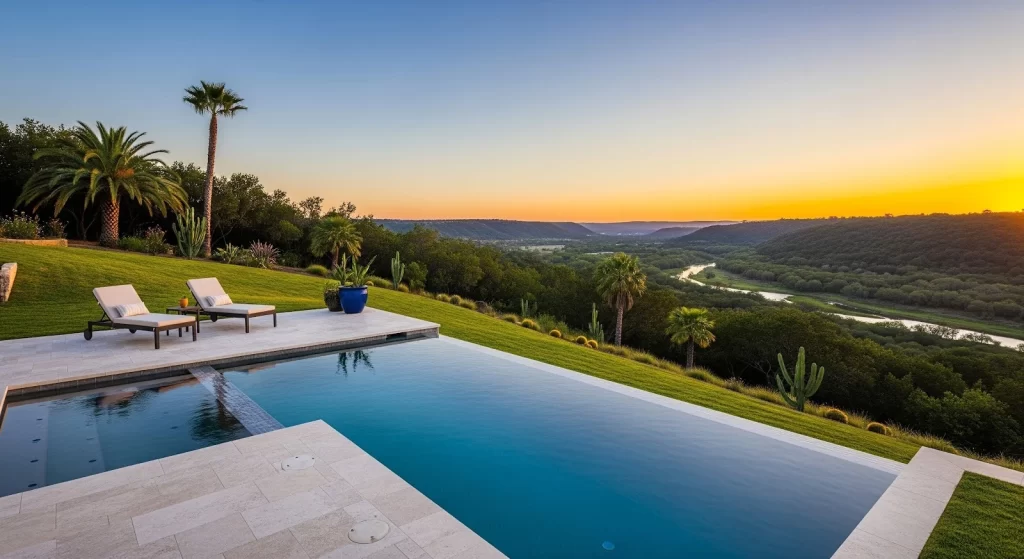
When your yard falls away (downward slope), it is often preferable to have the pool built partially out of the ground. It is wonderful in terms of indoor-outdoor living. You may step out of your back door onto a deck that reaches straight to the water, although the ground may drop away below you.
This method has been especially prevalent with contemporary fiberglass shells or concrete work. This method is the option of choice in limited spaces in coastal or hilly regions where the terrain is difficult. Indicatively, when you look at design trends like Plunge Pools Wollongong, you will notice the use of compact pool structures to overcome steep gradients without massive excavation. The pool turns into a water balcony.
The bare wall on the downside can be covered or paved with stones, and the pool will resemble an architectural element at the bottom of the garden.
The Hidden Costs of Building a Pool on a Slope
I believe in being honest with my clients. It is more costly to build on a slanting area than on a flat area. This is better known now than halfway through the project.
The additional money is typically spent here:
- Engineering and Soil Tests: You are handling structural loads that want to slide downhill. You require a structural engineer to approve the steel schedule and footing depth.
- Access and Excavation: Can a normal digger reach your backyard? On steep slopes, we are often forced to use cranes to hoist equipment in or soil out. When we are unable to drive a truck to the hole, the labor costs for earthmoving soar.
- The Concrete and Steel: A concrete pool required to retain a hill must have stronger walls and more reinforcement than a pool lying on stable soil that is not steep.
Why Soil Testing is Critical for Sloping Blocks
I have already discussed this, however, it merits a section of its own. Standard soil assumptions sometimes hold true on a flat block. Guessing on a slope is gambling.
You have to know what is going on down below. Is the soil shifting? Is there a stratum of rock which is going to cost a fortune to excavate? Does water flow down the slope of the ground?
I have witnessed amateur builders or unskilled workers attempt to avoid geotechnical engineering to save a few thousand dollars. Three years later, the pool shell breaks due to hill movement, or the patio begins to sink. Reverting a construction fault on a slope is a nightmare that may cost almost the same as the original pool. Get the tests done in advance; think of it as insurance for your sanity.
Managing Slope Drainage and Water Runoff
The following is one of the details that is not noticed until the first heavy rainstorm. As there is a slope, so goes the water down. When you set a pool in the middle of that flow, you are acting like a dam.
Unless you think about drainage, that water will pool against your structure and may even cause the foundation to settle or the patio to flood. We normally place French drains (Ag-lines) at the back of retaining walls to direct surface water around the pool. It is not the sexy part of building a pool, but it makes your investment safe when the storm season comes.
Finishing Touches: Sloping Yard Decking and Hardscaping
After you have the shell of the pool worked out, you have the surrounds to attend to. It is no use having a pool sloping down and having no level spot where a lounge chair can be placed.
Tiered landscaping comes in at this point. It could be a pool level, a fire pit on the lower terrace, and a dining area closer to the house. It takes professional dexterity to incorporate these levels. You are likely going to seek the services of a specialty patio builder who also knows how to tie the hardscaping to the pool coping as they navigate the transitions between levels.
Timber or composite decking can easily become a dear friend on drops as it cantilevers over the edge of the drop-off, providing level ground without requiring loads of concrete or fill.
Final Thoughts
So, can you build on a slope? Yes. As a matter of fact, when you have the courage to undertake the challenge, you are likely to have a better-looking backyard than your neighbor with the flat pancake back lot.
It takes time, a somewhat increased budget, and a team that knows gravity. When you are floating in your pool, gazing across the landscape that can be furnished only by a slope block, you will not be thinking of the engineering. You will only wish you had not listened to the people who said it could not be done.