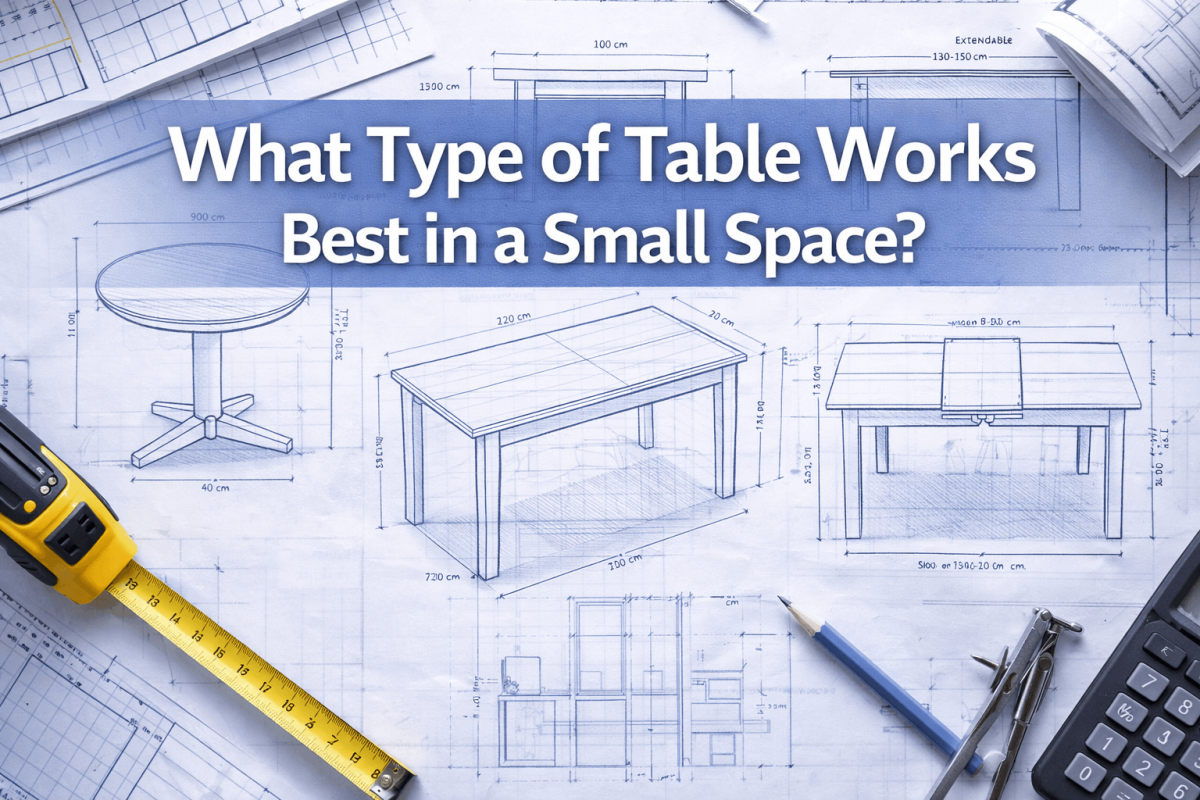
The best table for a small space uses compact dimensions, efficient shapes, and flexible designs, with round tables at 90 cm diameter, square tables at 75–100 cm, and slim rectangular tables at 120 × 75 cm fitting rooms between 6–10 m² while maintaining 60–80 cm clearance.
Small spaces demand precision.
A table that fits physically can still fail functionally. The correct choice balances shape, clearance, and usability within limited floor area.
Which table shape saves the most space in small rooms?
Round table shape saves the most space in small rooms because circular edges improve traffic flow, eliminate corners, and allow 90 cm diameter tables to fit within 2.4 × 2.4 m rooms while seating up to four people.
Round shapes improve movement.
Circular edges reduce collision points and create smoother pathways. According to spatial layout principles, curved edges improve movement efficiency in confined areas.
However, narrow rooms benefit more from rectangular forms aligned to walls.
Are rectangular tables better for narrow spaces?
Rectangular tables work best in narrow spaces because slim dimensions such as 120 × 75 cm align with wall edges, preserve walkway clearance, and maximise usable seating in rooms under 2.5 m width.
Shape must match layout.
A round table disrupts flow in a galley-style room. A narrow rectangular table maintains directional movement and prevents bottlenecks.
Wall placement also reduces required clearance on one side, saving up to 60 cm of space.
What size table fits comfortably in a small room?
Small room table size should range between 60–100 cm depending on seating needs, with two-person tables at 60–75 cm and four-person tables at 90–100 cm, requiring total room size of at least 2.4 × 2.4 m including clearance.
Size includes movement space.
A table alone does not define fit. Clearance of 60–80 cm around seating determines usability. A 90 cm table requires at least 240 cm total room width for comfortable use.
Are extendable tables a good solution for small spaces?
Extendable tables provide flexible sizing by expanding from compact dimensions such as 100 cm to 130–150 cm, allowing daily space efficiency while accommodating additional guests when required.
Flexibility improves usability.
Drop-leaf and extendable designs reduce permanent footprint while maintaining capacity. These designs support both everyday use and occasional hosting without requiring additional furniture.
What table base is best for maximising legroom?
Pedestal table base maximises legroom by removing corner legs, allowing 60 cm seating width per person and improving flexibility in seating arrangements compared to four-leg designs.
Base design affects comfort.
Corner legs restrict knee space and seating positions. A central pedestal allows chairs or benches to be positioned freely around the table.
How much clearance should you leave around a table?
Table clearance should measure 60–90 cm around all accessible sides to allow chair movement and walking space, with minimum clearance of 60 cm and optimal clearance of 75–80 cm for daily use.
Clearance defines usability.
Insufficient clearance forces restricted movement and reduces comfort. According to interior space planning standards, circulation space directly affects room functionality.
Do visual materials affect how large a table feels?
Table material and finish affect perceived size, with glass and light wood reflecting more light and reducing visual weight, while dark or bulky materials increase perceived mass within small spaces.
Visual weight matters.
Glass surfaces allow light transmission, making rooms feel larger. Light finishes reflect up to 70–80 percent of light, improving brightness in compact interiors.
Heavy solid forms can feel oversized even when dimensions are correct.
How do you choose the right table for your space?
Choosing a table for a small space requires measuring room dimensions, selecting a shape that aligns with layout, ensuring clearance of at least 60 cm, and prioritising multi-functional or extendable designs.
Use this decision framework.
- Measure total room size and usable area
- Select shape based on room layout
- Calculate clearance requirements
- Choose size based on seating needs
- Prioritise flexibility where possible
This approach ensures practical fit and long-term usability.
Where can you find space-efficient furniture solutions?
Space-efficient furniture collections include compact, multi-functional tables designed with proportion, material balance, and flexible sizing to suit smaller interiors.
Explore options here: https://petalwoodinteriors.co.uk/
Coordinated furniture collections help maintain visual consistency while optimising space across multiple pieces.
Final takeaway: what table works best in a small space?
The best table for a small space combines compact dimensions, appropriate shape for the room layout, sufficient clearance, and flexible functionality, with round, square, or extendable tables providing the most effective solutions.
Small spaces reward smart choices.
The right table creates function without sacrificing movement.